
15 April 1452. Birth of a Genius. Leonardo da Vinci.
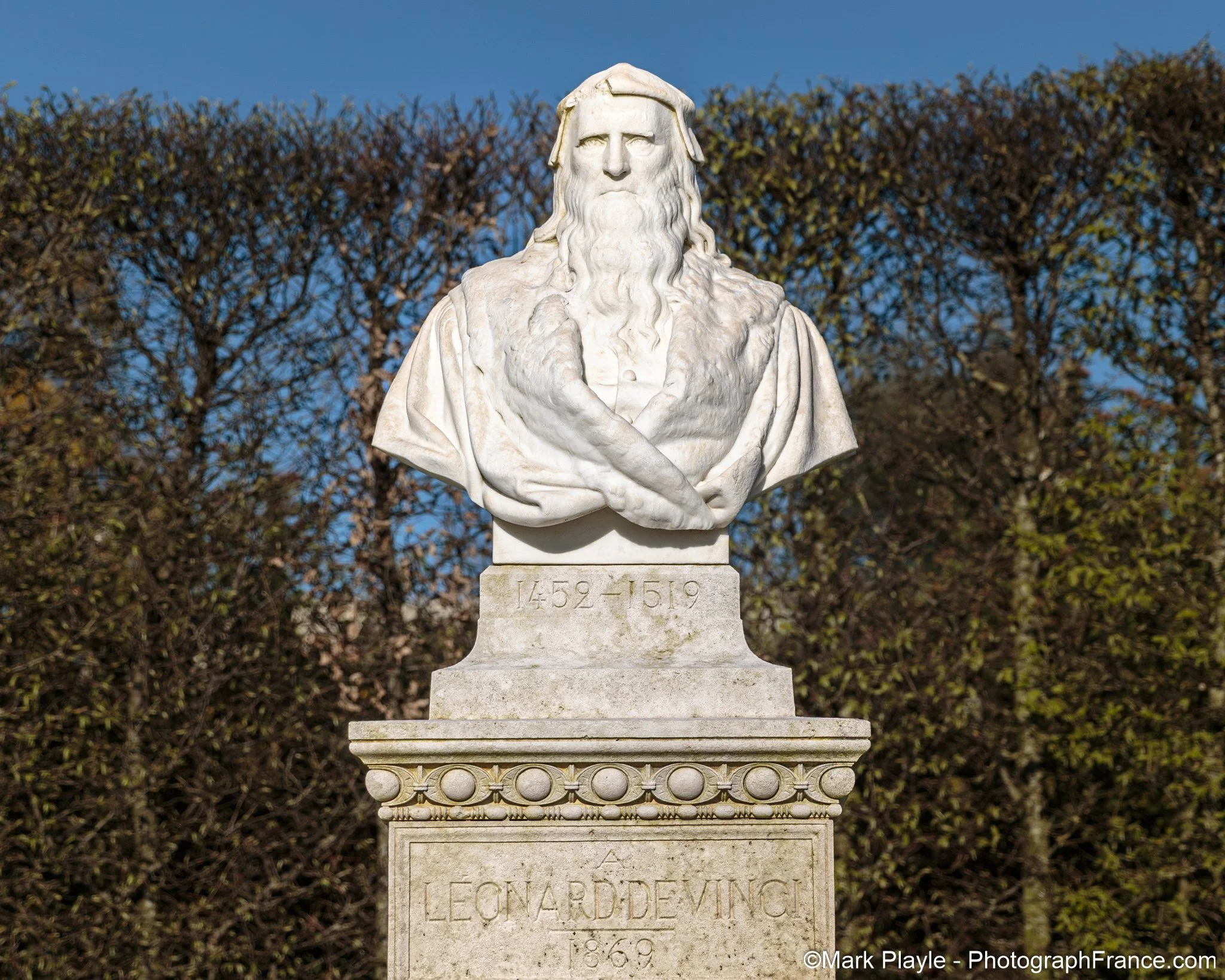
Bust of Leonardo, Royal Château Amboise. Photo: Mark Playle
Born illegitimate without a legal name to Caterina, a fifteen year old servant girl, the name of Leonardo da Vinci is now the most famous on the planet.
The Casa Natale (house where he was born) was and still is, a small stone farmhouse in a tiny hamlet of Anchiano in Tuscany, Italy.
So why is he not Leonardo d' Anchiano?
Anchiano was administered by the much larger Commune of Vinci. Also, the farmhouse belonged to Leonardo's paternal grandfather, Antonio da Vinci, a retired lawyer.
After Leonardo’s birth, Caterina was married off to Antonio di Piero Buti, a lime kiln worker from the village of Campo Zeppi. The kiln was just one of many which paint a rather different picture of the Tuscany of the poets. Kilns had to be fed round the clock. Men worked in shifts heating limestone to over 900°C. The smoke could be seen, smelled and tasted for many miles around.
Some 'experts' even suggest that Leonardo's famous misty sfumato is a nod to his step-father's lowly but essential occupation.
Signor and Signoria Buti had five children. Leonardo was living with his mother when his half-siblings Piero (1454) and Maria (1457) were born.
He left to live with his grandfather in Vinci when he was five, to be raised in a way befitting the son of a lawyer.
To think, Leonardo might have ended up as a kiln worker.
Antonio recorded Leonardo’s birth on his 1457 tax return as Leonardo, five years old, illegitimate son of the said Ser Piero.
Antonio, was fond of his only grandchild. Leonardo was seventeen when Antonio died.
He was Piero's only child for twenty-four years.
The boy was close to his uncle Francesco who tended the family olive groves and vineyards with young Leonardo in tow. He showed him how to track the flight of birds, how water moved in streams and the names of plants.
Leonardo seems to have had an idyllic boyhood. Because he was illegitimate he was not required to go to school. His grandfather probably taught him to read and write.
If he had been born on the right side of the blanket as the saying goes, he would have been schooled in Latin, the language of the law, the Church and State and Virgil, Cicero, and Ovid.
Then it would have been on to the University of Pisa or Florence to study Canon and Civil Law. Eventually he would have joined his father’s practice.
Florence lost a lawyer. The world gained a genius. Leonardo referred to himself as an omo sanza lettere, a man without letters.
When Leonardo was fourteen he was apprenticed to the studio of the famous artist Verrochio in Florence.
When he was thirty he was appointed Court Painter to Ludovico Sforza in Milan.
In July 1493, when Leonardo was in his forties, he wrote in his Notebook (Codex Forster) On the 16th day of July, Caterina came.
Shortly after she had buried her husband and her other son who died in a tragic accident, Caterina, almost sixty, grieving and ill, travelled from the Vinci area to see him in Milan.
Her four daughters never married and stayed in the family home. Was it the case that having just had the expense of two funerals, they did not have the money for hers?
Or did she want to see her first born for one last time?
She, nor any member of her family, ever exploited or made demands on Leonardo.
Leonardo was still Court Painter for his generous patron Ludovico Sforza.
She was surely very proud of her first child who was born in a farmhouse. He had come such a long way.
A few months later, Leonardo recorded the expenses for her funeral.
Caterina was probably buried in San Francesco Grande Milan where Leonardo painted Virgin of the Rocks.
He then began work on The Last Supper for Ludovico Sforza.
In 1503, Leonardo began his portrait of Lisa Gherardini (Mona Lisa) in Florence. She was twenty-four. He was about fifty.
When Francesco died in 1507, he left his entire estate to Leonardo.
The people who loved the boy genius best, his mother Caterina, his grandfather Antonio and his uncle Francesco were all gone.
His next devotee was the twenty-one year old Francis I, King of France who appeared on the scene when Leonardo was sixty-three and in desperate need of a friend.
Leonardo da Vinci ended his days happily collating the thousands of scraps of paper covered with his jottings. He died peacefully at home in the beautiful old manor house, Clos Lucé, in Amboise.
Caterina Buti. We salute and thank you.
Post by Pamela (BA History of Art). Photography by Mark.

Leonardo da Vinci: The Amboise Connection
by Pamela Shields
eBook, Paperback & Hardback
