
Yolande of Aragon. A Tribute. Part Three. Saumur.
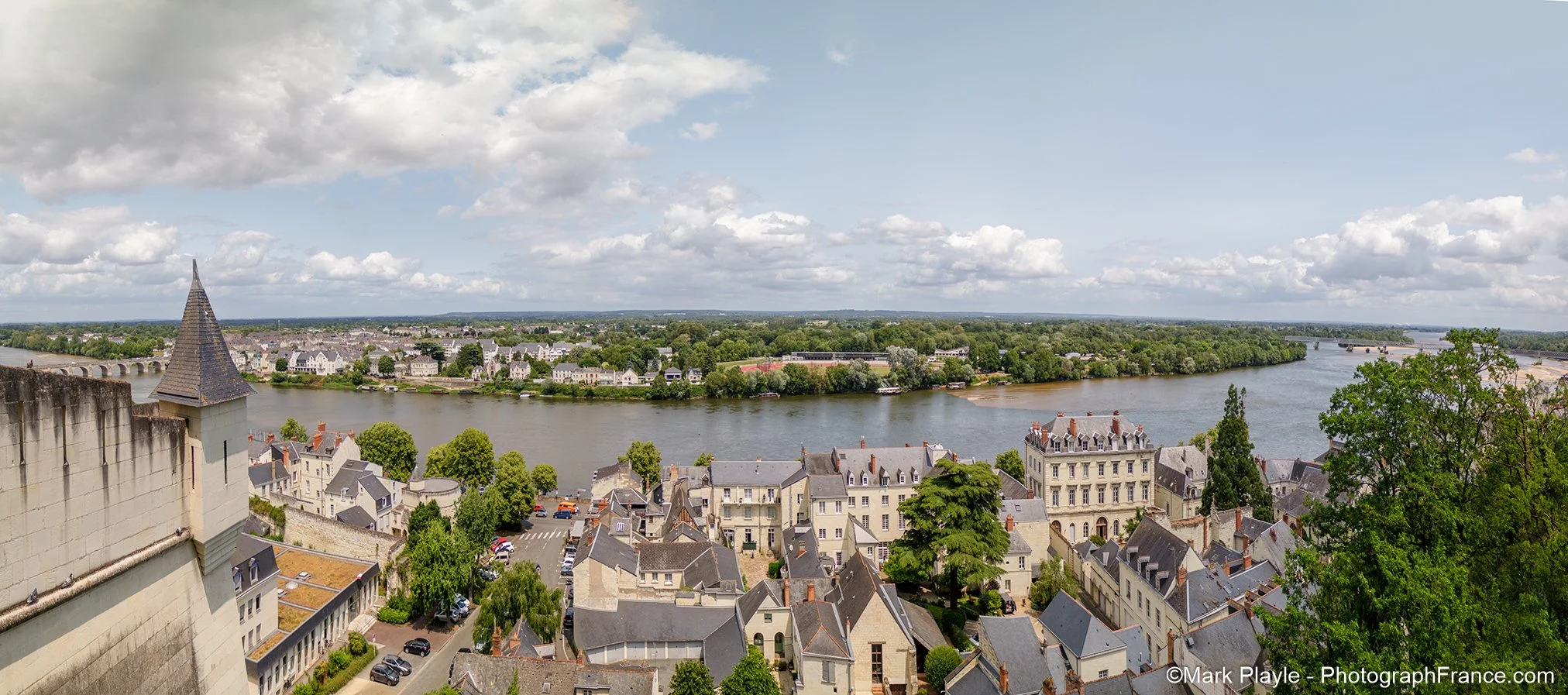
View of Île d’Offard from Château de Saumur. Photo: Mark Playle.
Following in my heroine’s footsteps, here I am in Saumur, in her favourite Château which has barely changed since she lived here.
Château Angers was Yolande's Head Office where she managed her multi-national portfolio as efficiently as any modern executive. She owned Anjou, Maine and Provence and made sure that when the Anjou line went extinct, the King of France would get the biggest inheritance in European history.
Château Saumur, where her children were, was her comfort zone.
The Official Guide in the Château said that very few have ever heard of Yolande. She knew she was buried in Angers but had no idea where she died.
I was on my own with that one, yet this is where Yolande raised a future King and Queen of France, a King of Naples and a Queen of England.
In 1413 during an uprising in Paris the mob broke into the royal apartments. Charles, the King of France's sickly, underfed, neglected eleventh child, saw courtiers being dragged out.
Yolande somehow got him out of the city and took him home with her. She had Châteaux in the Loire Valley and a private army where he would be safe.
After over a hundred years of being battered by England, thanks to Yolande it would be this boy, as Charles VII, who would get rid of the English. It would be his son, Louis XI (who Yolande helped deliver) who set about mending a broken France. Louis said his grandmother was 'the wisest woman in the kingdom with the body of a woman and the heart of a man.
When the ten year old Charles arrived in Château Saumur, he found stability, continuity, love and approval for the first time in his young life.
Yolande's children were his second cousins.
Her son Louis was the same age. Marie, his fiancée, was younger by a year, René by six, Yolande by nine and Charles by eleven.
Louis was King of Naples in waiting but died before he could take the throne. His brother René, who inherited the title, reigned for four years before being ousted. Yolande's money kept him on the throne.
Yolande raised his daughter, Margaret of Anjou and oiled the wheels which led to her granddaughter becoming Queen of England, the wife of Henry VI.
Yolande knew it was imperative for France that Brittany end its alliance with England but how to bring that about?
Easy. Marry her daughter Yolande off to the Duke's son and heir.
Yolande held the cards. She had royal connections. The power behind the French throne.
Then, of course, was her wealth and influence. Yolande was the wealthiest woman in 15th-century Europe.
Her French territories were gold mines. In the south, as Countess of Provence, she controlled one of the wealthiest regions in the Mediterranean. Anjou and Maine provided agricultural wealth and rents. Through her mother she inherited the industrial and mineral wealth of north-east France.
One of Yolande’s smartest financial moves was to take control over the salt marshes of the Atlantic coast and Provence and collect the tax (the gabelle).
The duke of Brittany sent embassies to Yolande to negotiate. As she was often with her daughter Marie and her grandchildren at Château Amboise, some of the formal agreements were signed there.
The marriage was in Nantes. The wedding reception was in Château Amboise. This union weakened England's power in France.
Yolande commissioned one of the most famous medieval manuscripts in the world as a wedding present for her daughter: The Hours of Yolande of Anjou is one of the great treasures of French medieval art.
When Brittany was annexed to France this exquisite work wound up in the royal collection. Then came the Revolution and The Great Dispersal. The treasures of France were looted or sold. Nobles who survived the guillotine sold their libraries to British collectors.
Lord Fitzwilliam bought Yolande's prayer book in 1808 during the Napoleonic Wars.
It's now in The Fitzwilliam Museum, Cambridge. Infrared reflectography revealed that the portrait of Yolande of Anjou is hidden beneath that of her successor Isabella Stuart of Scotland.
I wrote to the Minister of French Culture suggesting he raise funds to buy it back. It belongs in France.
Yolande worked for sixteen years to secure her son-in-law's right to the French throne yet in 1429 she was not at his coronation in Rheims.
Neither was his wife.
Why?
She stayed behind to care for Marie, who was pregnant.
This says all anyone need know about Yolande. She put her daughter's needs before her own.
Her son, René, who was at the coronation, reported back to her.
In 1431 Yolande found herself in an impossible situation.
The main reason why England was able to conquer France was because of the strong Burgundy-England alliance. Charles, duke of Burgundy, married the King of England's sister, Margaret of York.
Yolande spent years trying to convince Burgundians that England was too powerful and that a French peace was better for business. She was in the middle of negotiations to win them over to her side when she was told they had captured her protegée Joan of Arc.
Try to save Joan?
Or try to save France?
Only she knew what she went through when Joan was burnt to death. What a blow. What a tragedy.
She provided for Joan’s family and made sure Joan was seen as a martyr who sacrificed her life for France. She plotted with duke Louis of Amboise to murder Trémoille, the man who betrayed Joan.
They failed.
In exchange for his life, Louis was forced to hand over Château Amboise to the French Crown.
In 1440 Yolande, fifty-six, was, justifiably, exhausted.
She had borne six children. She had buried her husband and a son. As Regent she controlled Anjou and Provence. She had raised a future king and queen off France and a future queen of England. She had used her fortune to finance Joan of Arc's campaigns and to keep Charles VII on the throne. She financially and emotionally supported her son René in his struggles to hold on to his kingdom of Naples. She had weathered many bitter storms between her son-in-law Charles and her grandson Louis.
She had earned a bit of TLC. Her devoted lady-in-waiting and closest confidante, Jeanne de Tucé provided it.
She suggested Yolande move into her home on the island near Saumur, a new build with all mod cons.
The Château was cold, draughty and difficult to heat. Perched on a high, steep hill the climb was and is still arduous. Jeanne's Hôtel de Tucé was small, modern, easier to keep warm. It was on the flat, level with the town and the main road.
Yolande worked from home. It was from here she received ambassadors from the Holy Roman Empire to negotiate for her granddaughter, Margaret of Anjou to marry the ill fated Henry VI, King of England.
Yolande was there for two years. She died there 14 November 1442 after dictating her will.
She was fifty-eight. Jeanne was with her.
***
We walked over the bridge eager to see where Yolande died.
What a disappointment.
The house went by the names of Hotel de Tucé, Château de Tucé-de-Saumur, Château de la Reine and La Maison de la Reine de Sicile.
Now, sadly (for me) it's Château-Musée Anako.
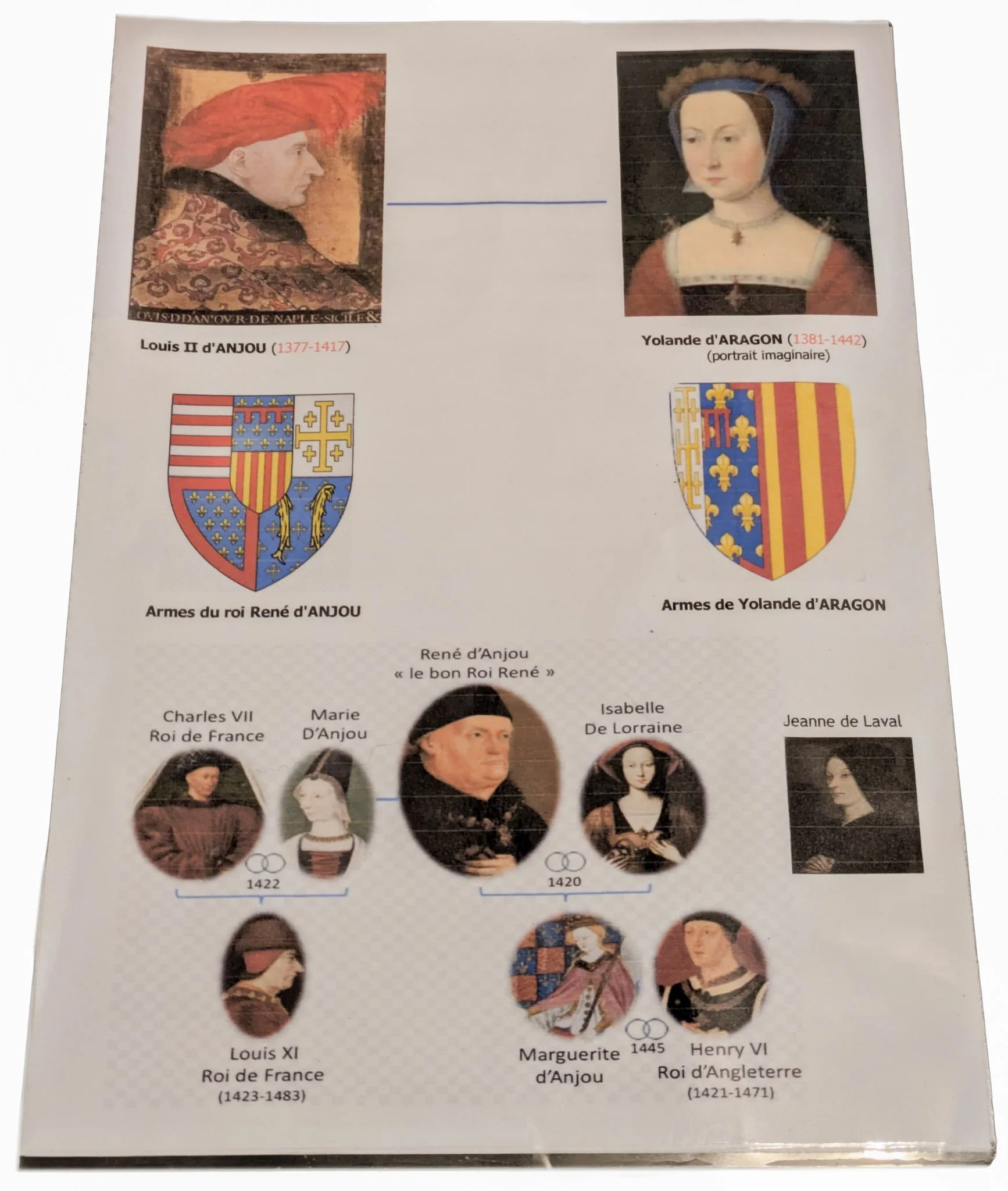
I looked for traces of my heroine. This laminated A4 sheet with imagined portrait of Yolande was all I found.
Post by Pamela Shields BA, Photography by Mark Playle.
Read more about Yolande
Out of the Shadows,
A Royal Childhood.

Read about Yolande's husband Louis II
and his failed claim to the throne of Naples in
Leonardo da Vinci The Amboise Connection.
